
Pool Salt Calculator
Salt chlorine generators only work within a narrow salt range — often around 2,700 to 3,400 ppm, depending on the manufacturer. Enter your pool volume (or its size), the current salt reading and your chlorinator’s target, and the calculator tells you how many 40 lb bags to add, or how much water to replace if the level is too high.
- Free to use
- No sign-up
- Runs in your browser
Quick answer
Pool salt calculator: To raise salt, subtract current ppm from target ppm, then use pounds = gallons × 8.34 × ppm increase ÷ 1,000,000. A 20,000-gallon pool raised from 2,400 to 3,200 ppm needs about 133 lb, or 3.3 40-lb bags. If current salt is too high, replace water with fresh water.
Pool salt calculator
Saltwater Pool Care Kit
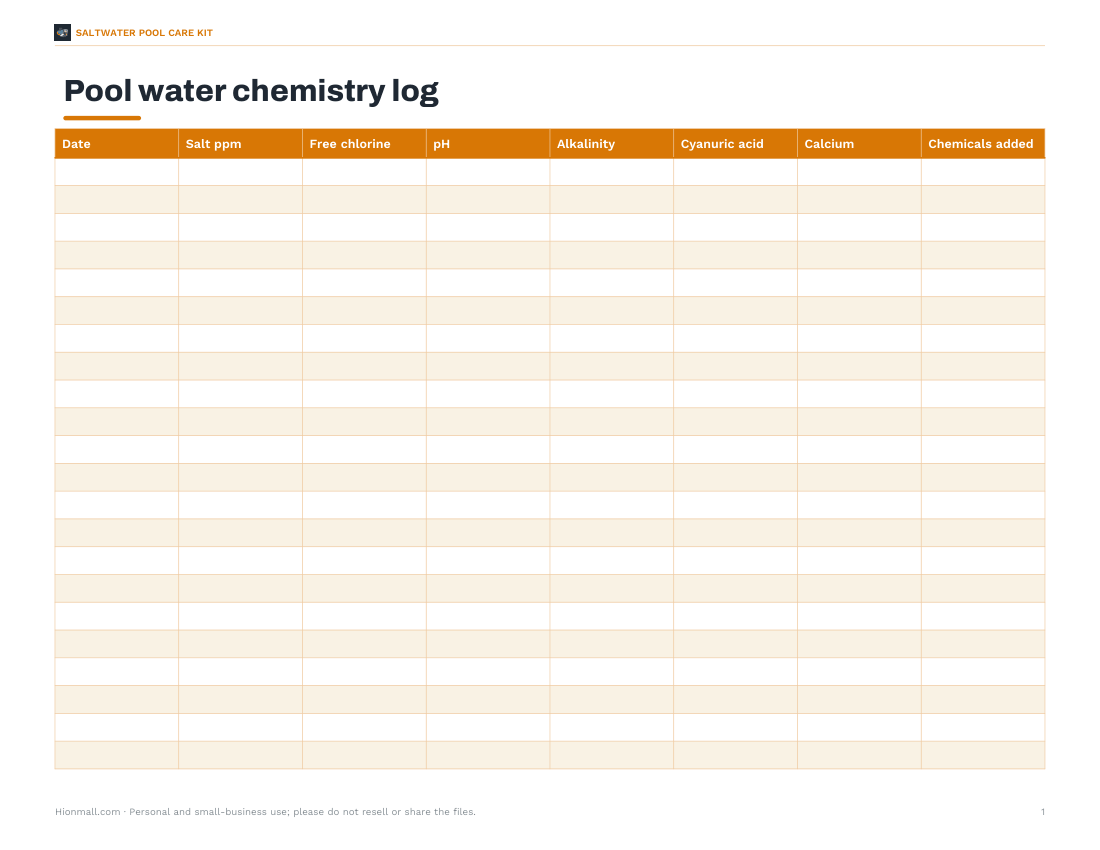
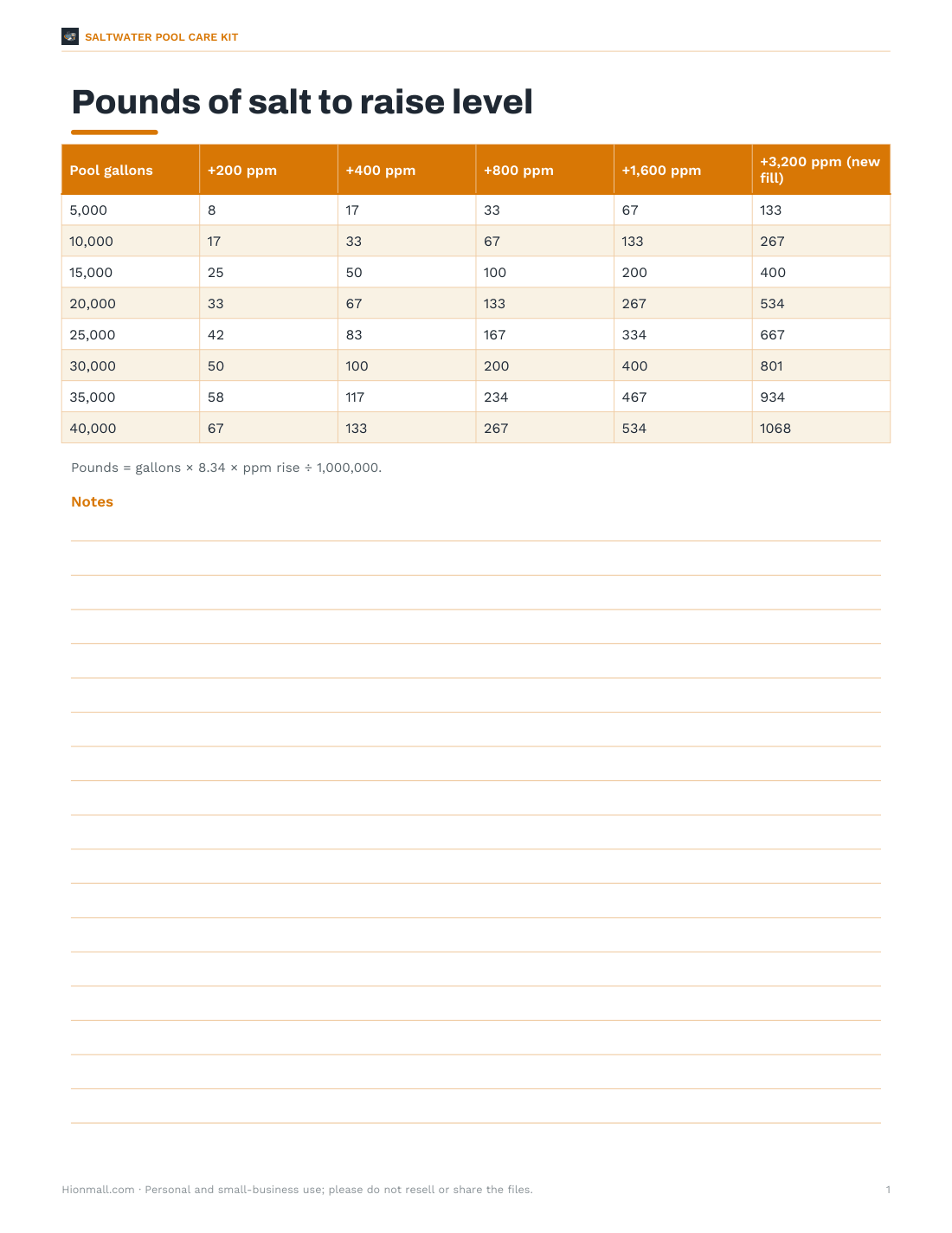
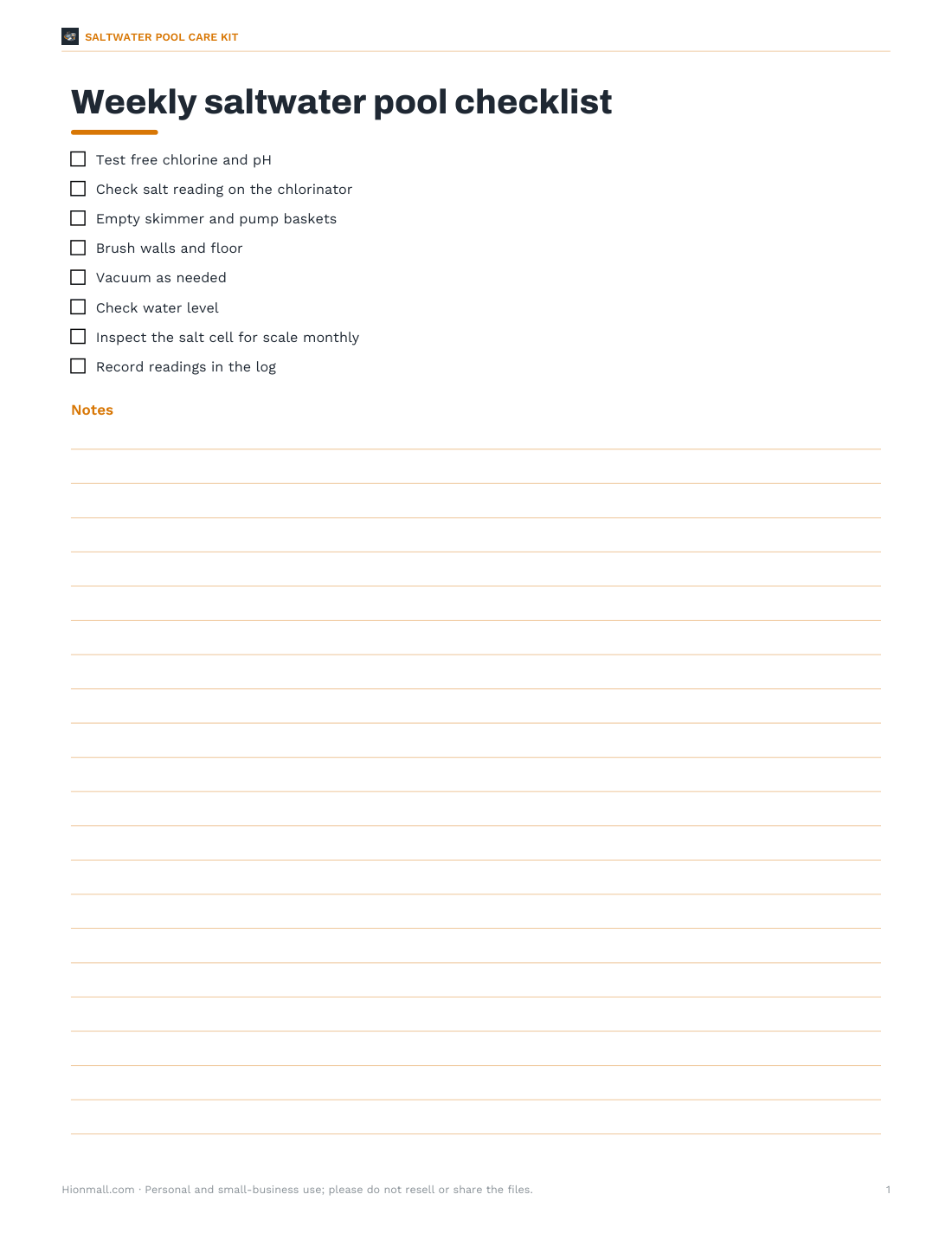
Saltwater pool care kit: Excel and printable water-chemistry log, a salt dosing chart for 5,000–40,000 gallon pools, a weekly maintenance checklist and opening/closing checklists.
- Chemistry log (XLSX/PDF)
- Dosing chart (PDF/XLSX)
- Weekly checklist (PDF, DOCX)
- Opening/closing (PDF, DOCX)
Formats: XLSX, PDF, DOCX. Instant download after payment (link valid 72 hours, up to 5 downloads). AI-assisted: the templates were drafted with AI help and reviewed and laid out before publishing.
$5.00 USD, one-time 4 files · about $1.25 each
- Instant download
- 7-day refund
- Secure checkout by Stripe
7-day money-back guarantee. Full refund within 7 days of purchase, even after you download.
Free sample: Pool Water Chemistry Log (PDF, 57 KB)
Full refund within 7 days — see the refund policy and license.
Free printables
Single sheets you can print right now, no sign-up. The full pack adds every sheet in one download plus the editable files.
 Printable Pool Chemistry Log
 Printable Pool Salt Dosing Chart
 Printable Weekly Saltwater Pool Checklist
 Printable Pool Opening and Closing Checklist
Pool Salt Chart by PPM Increase
Here are quick US estimates; metric users can calculate kg as litres × ppm rise ÷ 1,000,000.
| Pool gallons | Salt for +500 ppm | Salt for +800 ppm | 40 lb bags for +800 |
|---|---|---|---|
| 5,000 | 21 lb | 33 lb | 0.8 |
| 10,000 | 42 lb | 67 lb | 1.7 |
| 15,000 | 63 lb | 100 lb | 2.5 |
| 20,000 | 83 lb | 133 lb | 3.3 |
| 25,000 | 104 lb | 167 lb | 4.2 |
| 30,000 | 125 lb | 200 lb | 5.0 |
| 40,000 | 167 lb | 267 lb | 6.7 |
How the calculation works
Salt concentration in parts per million (ppm) is milligrams of salt per litre — or pounds per million pounds of water. A US gallon of water weighs about 8.34 lb, so the salt needed is: pounds = gallons × 8.34 × (target ppm − current ppm) ÷ 1,000,000. In metric, a litre of water weighs about 1 kg, so kilograms = litres × (target − current) ÷ 1,000,000. For a 20,000-gallon pool raised from 2,400 to 3,200 ppm, that is 20,000 × 8.34 × 800 ÷ 1,000,000 ≈ 133 lb — just over three 40 lb bags.
Pool volume formulas
| Shape | US (gallons) | Metric (litres) |
|---|---|---|
| Rectangle | L × W × average depth × 7.48 | L × W × average depth × 1,000 |
| Round | 3.14 × radius² × average depth × 7.48 | 3.14 × radius² × average depth × 1,000 |
| Oval | 3.14 × (L/2) × (W/2) × average depth × 7.48 | 3.14 × (L/2) × (W/2) × average depth × 1,000 |
Average depth is the shallow depth plus the deep depth divided by two. For pools with a large shallow area, weight the average towards the shallow depth. Your pool builder’s documents or the chlorinator installation records may list the exact volume.
Target salt levels
Every salt chlorine generator has a recommended range — commonly somewhere between about 2,700 and 3,400 ppm, with an ideal around 3,000–3,200 ppm for many popular models, but some systems are designed for lower or higher levels. Always use the figure in your chlorinator’s manual. Too little salt makes the cell work harder and produce less chlorine; too much can trigger alarms, shut the cell down or increase corrosion risk for metal fittings.
How to add salt
- Test the salt level with test strips or a digital meter, and check the chlorinator’s reading too.
- Turn the salt chlorinator off (the pump stays on).
- Pour the salt around the shallow end or the perimeter, away from the skimmer and main drain.
- Brush the salt towards the deep end to help it dissolve.
- Run the pump for 24 hours to circulate the water.
- Retest, then switch the chlorinator back on.
Worked example
A 32 × 16 ft rectangular pool, 3.5 ft deep at the shallow end and 6 ft at the deep end, has an average depth of 4.75 ft and a volume of about 18,190 gallons. Raising it from 2,400 to 3,200 ppm needs 18,190 × 8.34 × 800 ÷ 1,000,000 ≈ 121 lb, or four 40 lb bags (3.0 bags exactly — buying four covers a little extra).
When salt drops
- Splash-out and backwashing remove salty water.
- Heavy rain dilutes the pool.
- Draining to lower cyanuric acid or calcium removes salt too.
- Salt does not evaporate — topping up with fresh water after evaporation keeps the level the same.
Testing salt accurately
Salt chlorinators estimate salt from the cell’s electrical conductivity, and readings drift as the cell ages or scales up. Confirm the reading with salt test strips or a digital salinity meter before adding a large amount, and test after the pump has run for a while so the water is well mixed. Water temperature also affects some cell readings — many systems read low in cold water, so check your manual before topping up in spring.
Salt and other water chemistry
| Reading | Typical target for saltwater pools |
|---|---|
| Free chlorine | about 1–3 ppm (follow local guidance) |
| pH | 7.2–7.6 (salt pools tend to drift upward) |
| Total alkalinity | about 60–80 ppm for many salt pools |
| Cyanuric acid (stabiliser) | about 60–80 ppm outdoors |
| Calcium hardness | about 200–400 ppm |
| Salt | as specified by your chlorinator |
Ranges vary by pool surface and equipment; your chlorinator and pool finish manufacturers’ guidance comes first.
Choosing pool salt
Use salt made for pools: at least 99% pure sodium chloride, without anti-caking agents or iodine. Fine-grained salt dissolves faster. Rock salt, water softener pellets with additives and table salt with iodine can cause staining or cloudy water.
What the template pack includes
Printable and Excel pool care logs for salt, chlorine, pH, alkalinity, cyanuric acid and calcium, a salt dosing chart for common pool sizes, a weekly maintenance checklist and a seasonal opening and closing checklist.
Frequently asked questions
How do I calculate salt ppm for a pool?
To estimate the ppm increase from added salt, use ppm increase = pounds of salt × 1,000,000 ÷ (gallons × 8.34). In metric, ppm increase = kg of salt × 1,000,000 ÷ litres.
How accurate is a pool salt chart?
A chart is only as accurate as your pool volume and salt test reading. Use it for a quick estimate, then circulate the water and retest before adding more salt.
How many bags of salt should I buy?
Divide the calculated pounds of salt by your bag size, usually 40 lb in the US. If it is not a whole number, buy the next bag but add the last portion gradually and retest.
How much salt do I need for a 20,000-gallon pool?
About 0.83 lb per 100 ppm rise per 1,000 gallons — so about 133 lb to raise 20,000 gallons by 800 ppm.
What should the salt level be in a saltwater pool?
Follow your chlorinator’s manual; many recommend around 3,000–3,200 ppm.
How long does pool salt take to dissolve?
Usually several hours; circulate for 24 hours before retesting.
What if I add too much salt?
Partially drain and refill with fresh water; the calculator shows how much.
Can I use table salt?
Only if it has no iodine or anti-caking additives; pool-grade salt is best.
Does salt evaporate from the pool?
No, only water evaporates; salt is lost through splash-out, backwashing and draining.
How do I calculate pool volume?
Length × width × average depth × 7.48 for gallons, or × 1,000 for litres when measured in metres.
Should I add salt with the chlorinator on?
Turn the cell off while the salt dissolves, keep the pump running, then switch it back on after 24 hours.
Can I add salt to a new pool straight away?
Follow your pool builder’s advice; new plaster often needs to cure before salt is added.